
Blog

Reducing Waste in the Kitchen

Reducing Waste in the Kitchen

A Zero Waste Month guest blog by Margo Stoney

"For several years in a row, I’ve made a New Year’s resolution to waste less food."

The first couple of years, I made a feeble effort which consisted of trying to be better and mindful about eating leftovers, making smaller grocery runs for fruits and vegetables so they don’t spoil and simple actions like that. Sure, I wasn’t throwing away bins full of food but I didn’t feel like I was moving the needle on my own food waste reduction.

After thinking my resolution through and what it could take for me to make serious strides to change the way I envisioned, I realized I had no way of holding myself accountable. I felt only guilt with no other consequence when I threw away food. I have many reasons for not wanting to waste food–climate change and the environment are the most important reasons.

Climate change and food waste are intertwined in many complex ways. American households waste 27 million tons of food every year, and about 35% of food that’s produced in America never makes it off grocery shelves and goes unsold or does make it off the shelf and is uneaten. Growing, transporting, and selling food takes countless resources including water, energy, labor, and fuel. 

When food is wasted, embedded resources are wasted, too. 

This mass waste leads to the creation of a larger carbon footprint and more water scarcity. Sometimes food gets composted, which is great, but the majority of wasted  food is transported to an already overflowing landfill. Right there is the cost of transportation again –and something to continue thinking about and realizing is how in every part of the supply chain, there are expended resources and from there, resources that get wasted. Asking how our impact can lessen this waste is critical. 

Food waste makes up nearly 25% of solid waste in landfills which can lead to increased methane emissions and infrastructure problems, such as a landfill reaching capacity. If that occurs, then more land is needed to create another landfill. Creating another landfill takes more resources and more resources puts a strain on an already strained system and already strained planet.

So, after all that doom and gloom, I continuously ask myself, what can I do about it and I hope you’re asking yourself the same question. As a collective, what can we do about it? We each have the power to create and make positive change. We just need to start and take action. 

I created tools to help me understand how and why I was wasting my food so that I could fix the problem, and I’m sharing them with you with the hope that they’ll help you too. Please steal these ideas, share them far and wide and use them often!

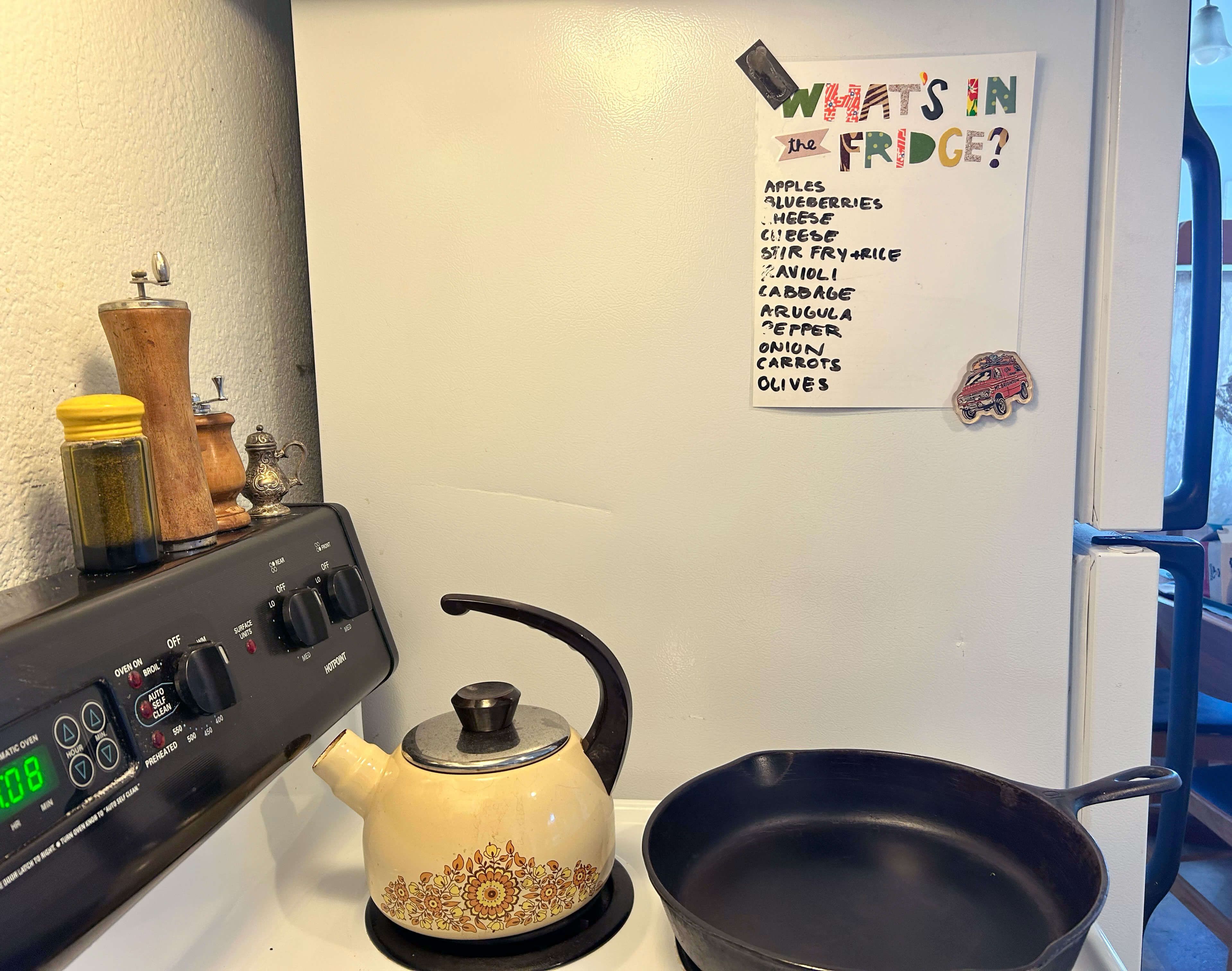
Create a “What’s in the Fridge”  list. 

On the side of a fridge is a piece of paper "What's in the Fridge?" with a list of perishables.

I keep a running list of fresh fruits and vegetables, as well as any leftovers, on the fridge as a visual reminder so that I don’t forget what needs to be eaten, and so that everyone in my household knows what needs to be eaten before purchasing new food. 

This list helps my family know what’s available for cooking and eating before going out and buying groceries or cooking a new meal. Using what exists is important before sourcing anything new. 

I created my own “what’s in the fridge list” and laminated it to use with a dry erase marker. You could also use a chalkboard dry erase board or a piece of scratch paper in a notebook that lives on your counter and gets updated every week.

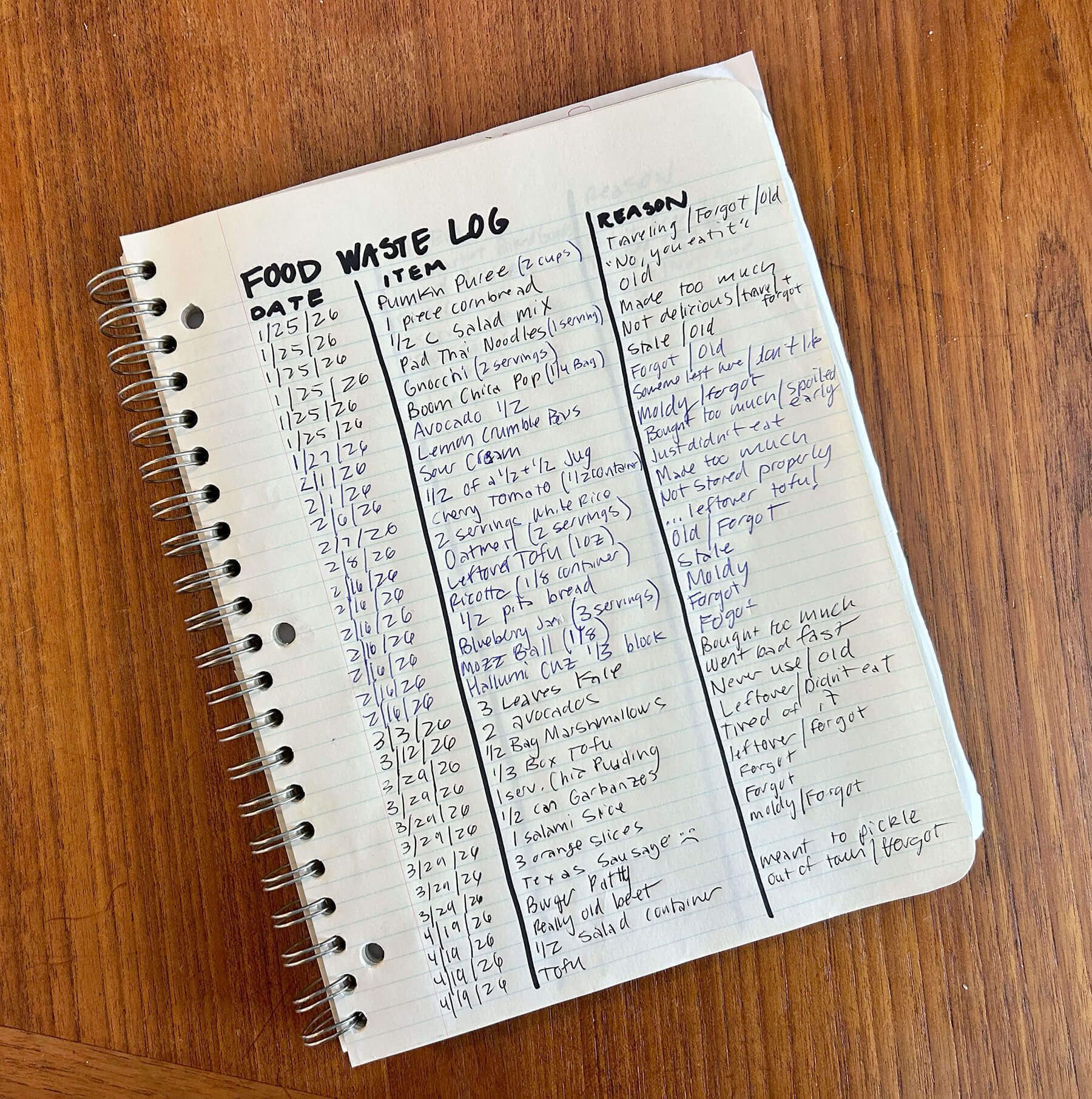
Start a Food Waste Log.

A hand-written food waste log in a notebook featuring three columns: Date, Item, and Reason.

This one can mentally hurt, and sometimes I call it the “Toss of Shame.” Yes, the list is supposed to make you feel a little guilty about your food waste but the intention is to take inventory and make adjustments and improvements as you go. 

The log is a catalog of any food that gets wasted, compiled in one place. Each time I add something to the list feels like salt in the already gaping wound I have about the environment and climate, but the reality is, this log helped me recognize patterns in the types of food I was wasting and why I was wasting them. 

Knowing the repeat offenders – the stir fry that I got tired of eating after day three, the tofu which is only eaten by me and typically in small amounts, and that expensive cheese that molded because I was saving that last morsel for a really special occasion that never happened like I wanted it to –helps me understand what changes needed to be made in order to avoid future waste. 

Try keeping a log even if it’s only for a week at first to make notes of your household’s patterns. Then try two weeks, then three, and work up to a month. Or go all in and start with tracking a month! Monitor what's repeatedly getting thrown away. Are you making too much of one meal or buying too much of one type of produce? What foods are never on your list (eat more of that!)? 

Labels labels labels!

Make sure everyone in your house knows what everything is, what it’s for, and how old the food item is. Sometimes something perfectly delicious can get lost in a crowded fridge and a simple label can be a great reminder and a meal lifesaver. Labels can be really helpful for busy families too. 

The goal is when any person opens your fridge, they know at a glance what’s ready to eat. 

I use a roll of colorful painter’s tape or brightly colored sticky notes and a big, bold sharpie –these are highly visible, easy to write on, and they take minimal effort to remove them from containers once they’re empty. 

Now, I know what you may be thinking –isn’t this a waste then of tape and sticky notes? Yes, but these are tools to decrease overall waste and for me, I think it’s worth it.

Have a food rescue toolbox. 

Knowing what to do with excess food is an important step to avoiding food waste. Having awareness of what you can do with excess food will decrease food waste in the long run. I’ve found it’s best to have a couple of options in place for when you start feeling something is at risk of heading to the trash.

  • Fill your freezer. Not going to finish that spinach? Blanch and freeze it and then use it in soups or smoothies. Not going to finish those eggs before you leave on vacation? Crack em’ and make and freeze a veggie frittata. Your future self will thank you on a busy week when you have premade meals on hand. 
  • Learn simple preservation methods. Canning, freezing, pickling, and dehydrating are all great ways to keep food longer. I’m personally not confident in my canning abilities, so I stick to refrigerator pickling, dehydrating, and freezing. There’s always room for improvement!
  • Normalize sharing food with friends and gifting food to neighbors. The day you made too much spaghetti might be the day your friend had to work late and came home to an empty fridge. That neighbor who lives solo now might want the rest of your meatloaf for dinner because cooking for one person can be tough. It can’t hurt to have a few friends on hand and know your neighbors so that you can message about extra veggies or leftovers. 
  • Upcycle your leftovers. One of the top offenders on my Toss of Shame list is that I “got tired of eating the name of the thing that I made and after day 4, I’m just over it.” To remedy this, I’ve started getting creative with turning leftovers into a new dish. Leftover noodles can become pasta frittata (my friend’s mom used to make this for soccer team dinners in high school and I still remember how delicious it tasted), white rice into rice pudding, roasted potatoes into an omelet –there are many ways to reuse leftovers with a little creativity and effort!
  • Find a little free pantry. Similar to a Little Free Library, little free pantries are community-built and -run boxes or shelves placed in neighborhoods for people to share food with those who need it. Look for one in your neighborhood and learn about what types of food donations are acceptable. And then, utilize it. 

As consumers, we don’t have much control over the monstrous full-scale food system and the items that go to waste in places such as restaurants and grocery stores, or during the transportation and production processes. However, grassroots efforts in our own homes and communities can help change the conversation about how we use and value food. 

Reducing waste can be one way of showing gratitude and appreciation for having access to healthy food, the farmers and ranchers that produce the food we eat, the land that provides for us, and the people we get to share meals with. 

Now you try! 

October is Zero Waste Month, so it’s a great time to start your waste-less-food journey. I’d love to hear your favorite food-saving tips, what’s worked or hasn’t worked for you, and something new you’re excited to try. Send me an email [email protected] – I read every one!

Check out these free downloads:

Food Waste Log

“What’s in the Fridge" Printout

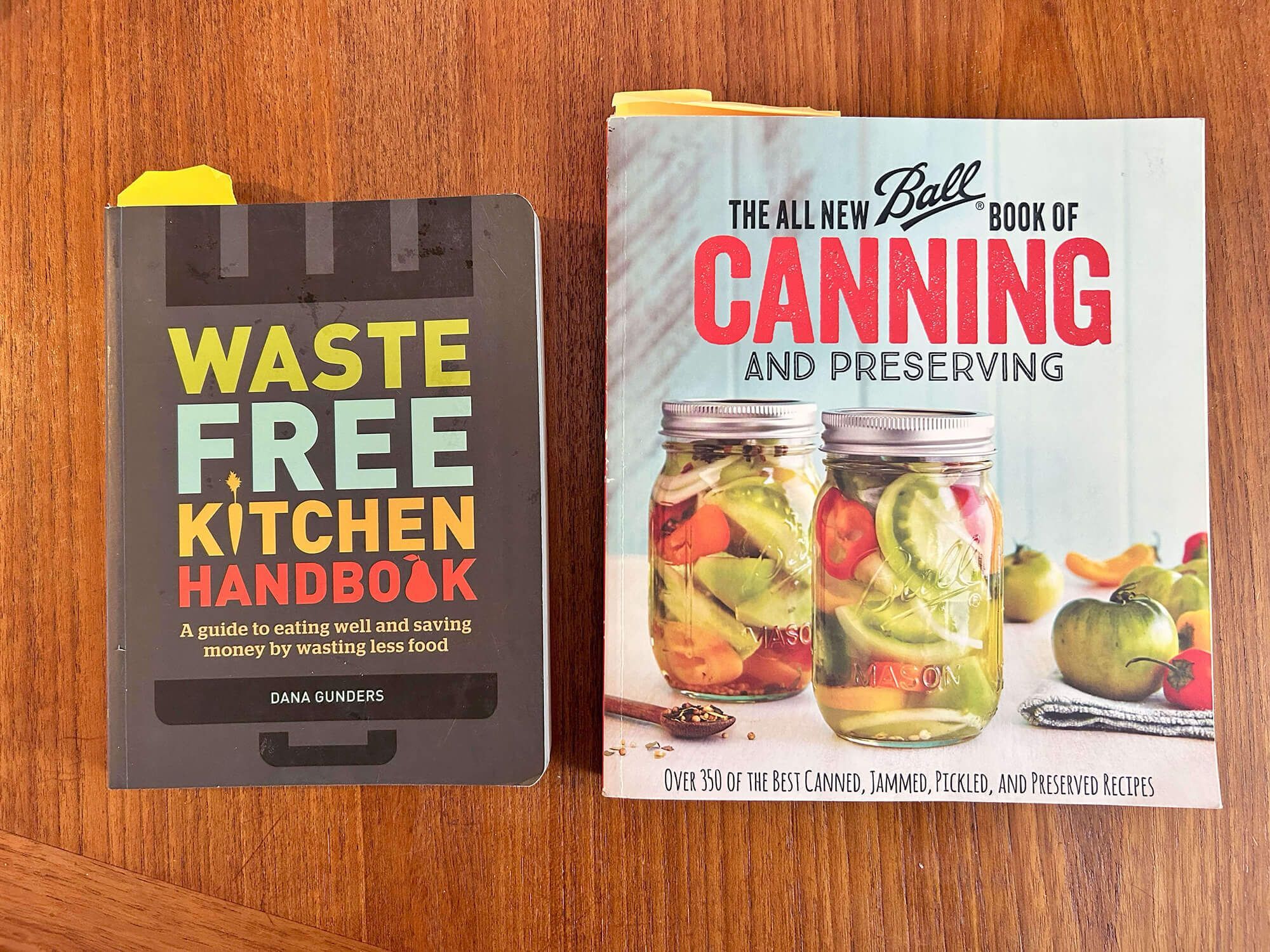
Read these books about reducing food waste: 

Two books: Waste Free Kitchen Handbook by Dana Gunders and The All New Ball Book of Canning and Preserving.

And join in: 

Food Waste Prevention Week 

Zero Waste Month 

Headshot of Margo Stoney

I’m Margo! I serve on the board of Race to Zero Waste and volunteer with Home ReSource, the sustainability center located in Missoula, Montana. I’m a graphic designer who works with conservation-minded nonprofits and brands on projects like logos & branding, annual reports, maps, and infographics. Visit my portfolio to see some of the projects I’ve collaborated on with nonprofits to protect the environment.

2025 Zero Waste Week & Forum Recap

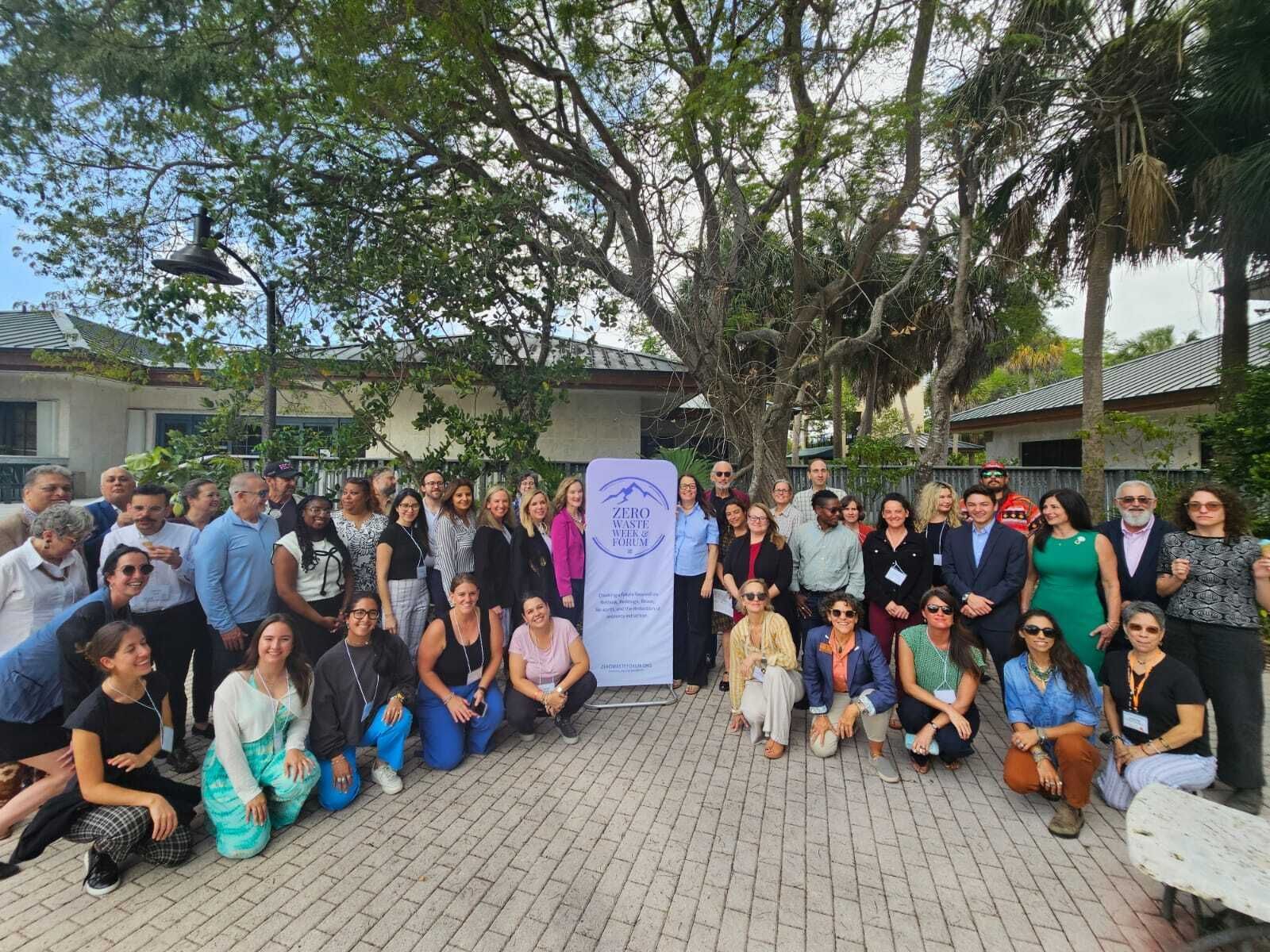
Group picture of Zero Waste Forum Day 2 attendees at the Anne Kolb Nature Center, with the light purple Forum banner in the center.

Race to Zero Waste, Debris Free Oceans, and Broward Clean Air were pleased to host a #ZeroWasteWeek full of connection and learning! 

March 30th, Beach Cleanup 

Beach cleanup participants spent a cloudy day on Hollywood Beach collecting bucketfuls of litter! We were glad that the weather held out for us until the very end. From a distance, it didn't seem like the beach was that dirty, but we found plenty of stuff to pick up on the sand, the dunes, and the "broadwalk." We ended up with ten full buckets at the end of the morning. Beach-goers were thankful and happy to help out if they had a piece of litter near them. We also saw some Portuguese man-o'-wars that had washed up! 

The cleanup activity was followed by a microplastics demonstration hosted by Dr. Samantha Romanick of the University of Rochester. She brought out her microscope and a monitor to tell us all about what can be found in ocean water samples. It may not be surprising at this point, but we saw microplastics in all the samples from the Florida Keys to Hollywood Beach. 

March 31st, Sustainability Tour at the University of Miami

25 attendees learned about the progress that the University of Miami is making towards reducing waste, implementing clean energy, and meeting LEED standards with their new buildings. 

Starting from the Herbert Wellness Center, we saw a box to recycle shoes with Sneaker Impact, which we learned is an important collaboration with the athletics department, since athletes go through shoes quickly. Next we moved outdoors to see the green campus, stormwater management, and an installation that is a small-scale example of the Big Cypress National Preserve ecosystem. 

The school makes efforts to help students recycle, including having Goodwill trucks at moveout, providing e-waste recycling in the book store, and have programs such as Cane's Resell, the Get Green app, and Glass4Life in one dining hall. 

Finally, we got a tour of the main dining hall and its inner workings, including methods to reduce food waste and the composting site, along with the O2Go reusable takeout containers that are available. We wrapped up with lunch from the many buffet options there, and many of us wished we had been able to go to a school with such a nice dining hall! 

We hope to see continued progress toward zero waste from UM, such as greater materials diversion, student education, and an expanded reuse system! 

April 1st, Forum Day 1 - Local Focus

At the first day of the Zero Waste Forum, in-person and online participants alike were blown away by the opening address and land acknowledgement from Garrett Stuart, aka "Captain Planet", founder of the Eco Preservation Project, who highlighted the importance of indigenous traditions, giving back to the earth, and the line that stayed with all of us, "Wasting is the same as stealing." 

We also had impactful presentations from youth keynotes Anagha Iyer, who spoke about advocacy and change-making among her peers in Broward County, and Lael Kylin Judson from Rural Roots Louisiana, who shared her family and community's experiences in Cancer Alley, where "industries prioritize profits over people." She proposed solutions to the pollution, including enforced regulations and diligent monitoring. "Support sustainable solutions instead of relying on polluting industries."  

Our third keynote speaker, Andy Weins, rocked the audience with his zeal, impactful message, and reminder that our "Words F***ing Matter"! Language is powerful and we can use it to motivate each other and connect with new groups. He poses us the question: "How do we get the word 'waste' out of 'zero waste'?" and encourages us to reframe anxiety as excitement. 

Local speakers and panelists joined us for deep dives into food waste, compost, and composting infrastructure; a motivating selection for right before our vegan, zero waste lunch! We also had a passionate panel on the dangerous impacts of incineration and burning plastics, particularly relevant in South Florida, as commissioners are considering a possible new incinerator for the region. 

A number of speakers gave their permission for their slides and recordings to be made available to the public! To see these expert speakers and more, check out our YouTube channel.

April 2nd, Forum Day 2 - National and International Perspectives

The second day of the Zero Waste Forum opened with friend of R20W, Michael Karapetian from EARTHDAY.ORG. One of our Emerging Leader Awardees, Michael talked about the power of community clean-ups and how they're a tangible way for folks to get involved in the environmental movement. While so many of us enjoy the immediate impact of a clean-up event, Michael emphasizes that we need to take action at the source for systemic change. He reminds us that those who organize clean-ups are "uniquely positioned to connect to other community members, including businesses and local governments to create change."

Our second keynote speaker of the day, Iuliia Markhel of Let's Do It Ukraine, joined us for a second year to discuss the impacts of war on people, the environment, and her own perspective on possessions and what we actually need to survive. She has been continuously fighting for the environment since 2022, living the consequences of the Russian invasion, including losing her house and belongings in a fire. She reminds us that we don't need to look for additional motivation to "save our nature --it's our health, oxygen, water, our everything." 

Adding to the international perspectives at the Zero Waste Forum was a panel on Global Case Studies, with perspectives from Brazil, Puerto Rico, and Sweden. We followed this with a series of speakers and panel on Zero Waste Policy & Solutions, where we heard from businesses and policy advocates on making zero waste a reality. 

A number of speakers gave their permission for their slides and recordings to be made available to the public! To see these expert speakers and more, check out our YouTube channel.

Appreciative Comments from the Zoom Audience

"Thanks to these brave speakers sharing very emotional issues, really powerful!" -Rhonda Roff

"Andy, your presentation was so inspiring!!  And critically important! Thank you so very very much!" "[Mike Ewall's] was this presentation I most wanted to hear!" "Thank you Jackie! That was an excellent presentation. I’ve learned so much from PPC!"- Maxine Lobel 

"Excellent points, Dr. Sobel! I hope the county commissioners are listening." - Noel Cleland 

"Florida’s effective actions were truly educational!" -Avra Rossman

"Iuliia's message struck me; it's a message without borders. You are very brave to present your intention to make a difference in your country and communicate it to the world at this historic moment. We must speak up to communicate how we are interacting even if we don't live in the same geographic region." - Noel Toledo

"I will definitely be reading the book that Kristine recommended as I continue to develop my knowledge of and thinking on plastics!" - Evan Belk

Sustainability in Action Awards

During both days of the Zero Waste Forum, Race to Zero Waste was pleased to award a few of this year's Sustainability in Action Awards in person. The Emerging Leader Awards went to speakers Michael Karapetian of EARTHDAY.ORG, Lael Kylin Judson of Rural Roots Louisiana, Anagha Iyer of the Broward Sierra Group Junior Team, and Amanda Di Perna of Debris Free Oceans. Jessica Namath of Palm Beach Clean Air received an Advocacy Award for her anti-incineration work. 

Other awardees who were not able to be present at the Zero Waste Forum, but will receive their awards later are: 

  • Allie Donohue, Founding Member and President of Maria Carrillo High School's Trash Club, who received the final Emerging Leader Award.
  • Deepa Lama of the Kalpavaatika Society Nepal, who received the advocacy award in person from R20W Board Member Dan Fritschen, for their work on building community awareness around zero waste solutions. 
  • Lisa Clark, founder of Sustainable Marin Schools, who received the Regenerative Community Award from R20W CEO Teresa Bradley at the North Bay Zero Waste Symposium. 

April 3rd, TRUE Zero Waste Workshop

On April 3rd, Race to Zero Waste hosted Celeste McMickle as facilitator of the TRUE Zero Waste Workshop. She provided information about the TRUE Zero Waste certification and its role in helping businesses meet their sustainability goals. 

Save the Date for the 2026 Zero Waste Week & Forum

We are excited to share that the 2026 Zero Waste Week & Forum is set to take place in Park City, Utah, in partnership with GreenEducation.US. Zero Waste Week will run from March 30th to April 3rd with a variety of activities, including a focus on sustainable tourism. We hope to see you there!

MENU CLOSE