
Blog

EPR: Making Producers Responsible for the Waste They Create

EPR: Making Producers Responsible for the Waste They Create

A Zero Waste Month guest blog by Amy Golan

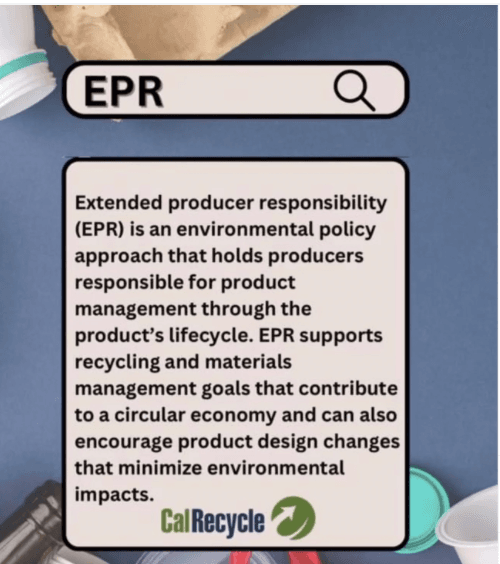
EPR stands for Extended Producer Responsibility—and it’s an important shift in how we deal with waste.

For decades, much of the responsibility for disposing of packaging has fallen on consumers and local communities. We buy a product, unwrap it, and then we're expected to figure out what to do with the packaging left behind.

EPR changes that equation.

Instead of putting the entire burden on consumers and municipalities, Extended Producer Responsibility makes the companies that produce and package products responsible for what happens to those materials at the end of their useful life.

And California is taking a major step forward.

Under California’s Plastic Pollution Prevention and Packaging Producer Responsibility Act, or SB 54, producers of covered packaging and single-use plastic food service ware are being brought into a statewide producer-responsibility system. California has approved Circular Action Alliance as its first Producer Responsibility Organization, or PRO, to help producers meet the requirements of the law.

What happens by 2032?

California has set some ambitious goals.

By 2032, the state requires:

  • 100% of covered single-use packaging and plastic food service ware to be recyclable or compostable
  • 65% of single-use plastic packaging and food service ware to actually be recycled
  • A 25% reduction in single-use plastic packaging and food service ware compared with 2023 levels

That's a big deal.

It means manufacturers will have a much stronger incentive to rethink packaging from the very beginning—using less material, designing packaging that can actually be recycled or composted, incorporating reuse and refill systems, and helping pay for the infrastructure needed to manage the waste their products create.

Why EPR Matters

Recycling alone was never going to solve our waste problem.

When companies can produce endless amounts of difficult-to-recycle packaging without being responsible for what happens to it afterward, there is little financial incentive to change.

EPR helps move us toward a more circular economy, where waste is designed out of products instead of being treated as somebody else's problem.

And the scale of the issue is enormous: packaging accounts for more than half of what California sends to landfills by volume.

The goal isn't simply to become better at throwing things away. It's to create less waste in the first place.

California's approach could help reshape the way products are designed, packaged and sold—not just here, but potentially across the country as companies adapt their packaging for one of the world's largest economies.

Let's lead the way in making manufacturers more responsible for the waste they create.

Let's make reducing waste part of the design process, not an afterthought.

October is Zero Waste Month, so it’s a great time to advocate for better systems where you live, too. What exists? What's needed? How can you join up with people in your area who are having these conversations? That's a #ZeroWasteAction, too! 

Headshot of Amy Golan

I’m Amy! I serve on the board of Race to Zero Waste and am the owner of Planet Renu, a zero-waste refill waste store, that has a physical retail space in Walnut Creek as well as an online store. Education is an important part of Planet Renu’s mission, providing the WHY in why everyone needs to live more sustainably.

How R20W Goes Zero Waste in its Operations

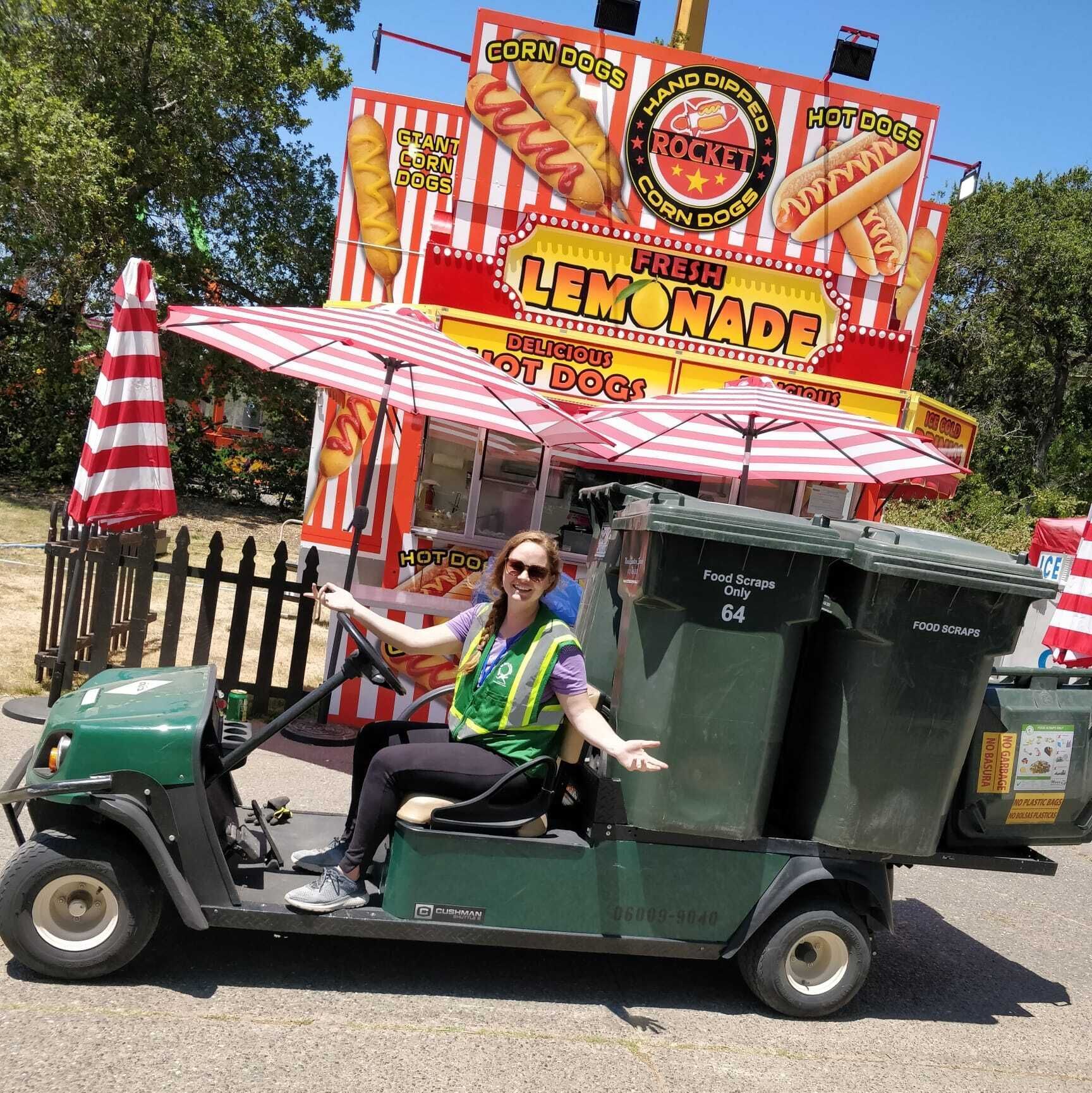
R20W staff member poses driving a utility golf cart, hauling compost toters at the Marin County Fair. She is in front of one of the hotdog stands.

At Race to Zero Waste (R20W), we are well-known for sharing our knowledge about reducing waste, reusing what you have, and recycling & composting correctly. But what happens behind the curtain? 

We do our best to take putting Sustainability in Action seriously and walk the talk! 

In fact, here are some Zero Waste Actions that we’ve implemented:

  • At Dolores Park, we use reusable towels to clean our Zero Waste Station Pop-Ups.  
  • At the Zero Waste Forum, we take into account the venue, food and beverage, and more, always doing what we can to nudge our hosts closer to zero waste. For example, we worked with a local restaurant to get reusable pizza boxes to use not just for the Zero Waste Forum, but for other catered events in the area, as well. 
    • Teresa and Hayden talked about the various ways we reduced waste at the 2026 Zero Waste Forum on our YouTube channel. Check it out here!
  • We purposefully avoid printing posters, flyers, business cards, and stickers. We only print a few strategic flyers a year, such as for Zero Waste Month and the Zero Waste Forum! 
  • At Zero Waste Fest and other events, we have worked with Stainable Ink, a local Bay Area company, to screenprint the R20W logo on up-cycled t-shirts that otherwise would have been thrown away. 
  • We’ve purchased pre-owned items like a clicker counter to collect data about the number of single-use cups we collected at Zero Waste Station Pop-Ups at Dolores Park (almost 2,000 cups per month, if you’re curious). 
  • When expanding our Zero Waste Station Pop-Up program to other organizations, the standing banner we purchased was made from 100% post-consumer recycled polyester from Go-GreenBanners.com.

Keeping the Zero Waste Hierarchy in mind.

It is important to note that we don’t always avoid waste 100%. Sometimes, we purchase items that are the lowest cost, the only ones available, or the best option to keep our team safe. 

While we know that some waste is still unavoidable, like some personal protective equipment (PPE) items, we always try to reduce first and keep reuse, followed by recycled content, at the top of our minds when making purchasing or operational choices. 

You can do it, too!

Can you think of any opportunities in your company or organization to implement a Zero Waste Action? Could you use reusables instead of single-use packaging? Purchase equipment second-hand? Buy supplies made from recycled materials?

Whatever you think of, make a commitment to doing it this October for #ZeroWasteMonth!


This blog was written by R20W Zero Waste Coordinator, Sherry Gong. 

AI transparency statement: No AI was used in the writing or editing of this blog. 

MENU CLOSE