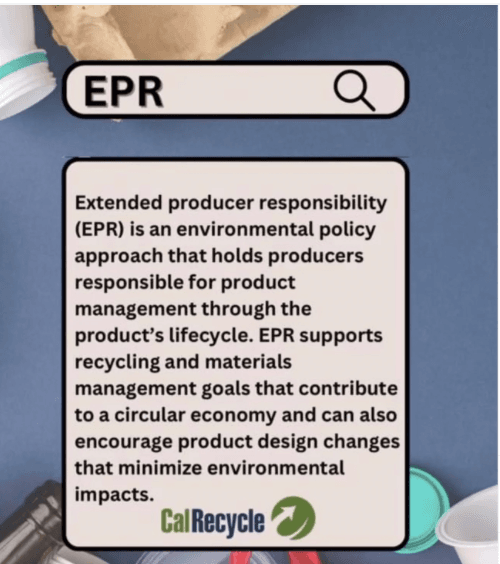
EPR stands for Extended Producer Responsibility—and it’s an important shift in how we deal with waste.
For decades, much of the responsibility for disposing of packaging has fallen on consumers and local communities. We buy a product, unwrap it, and then we're expected to figure out what to do with the packaging left behind.
EPR changes that equation.
Instead of putting the entire burden on consumers and municipalities, Extended Producer Responsibility makes the companies that produce and package products responsible for what happens to those materials at the end of their useful life.
And California is taking a major step forward.
Under California’s Plastic Pollution Prevention and Packaging Producer Responsibility Act, or SB 54, producers of covered packaging and single-use plastic food service ware are being brought into a statewide producer-responsibility system. California has approved Circular Action Alliance as its first Producer Responsibility Organization, or PRO, to help producers meet the requirements of the law.
What happens by 2032?
California has set some ambitious goals.
By 2032, the state requires:
- 100% of covered single-use packaging and plastic food service ware to be recyclable or compostable
- 65% of single-use plastic packaging and food service ware to actually be recycled
- A 25% reduction in single-use plastic packaging and food service ware compared with 2023 levels
That's a big deal.
It means manufacturers will have a much stronger incentive to rethink packaging from the very beginning—using less material, designing packaging that can actually be recycled or composted, incorporating reuse and refill systems, and helping pay for the infrastructure needed to manage the waste their products create.
Why EPR Matters
Recycling alone was never going to solve our waste problem.
When companies can produce endless amounts of difficult-to-recycle packaging without being responsible for what happens to it afterward, there is little financial incentive to change.
EPR helps move us toward a more circular economy, where waste is designed out of products instead of being treated as somebody else's problem.
And the scale of the issue is enormous: packaging accounts for more than half of what California sends to landfills by volume.
The goal isn't simply to become better at throwing things away. It's to create less waste in the first place.
California's approach could help reshape the way products are designed, packaged and sold—not just here, but potentially across the country as companies adapt their packaging for one of the world's largest economies.
Let's lead the way in making manufacturers more responsible for the waste they create.
Let's make reducing waste part of the design process, not an afterthought.
October is Zero Waste Month, so it’s a great time to advocate for better systems where you live, too. What exists? What's needed? How can you join up with people in your area who are having these conversations? That's a #ZeroWasteAction, too!
AI Transparency Statement: I used AI to help update this blog for 2026 since its original writing, including new information about 2032 and recent updates to EPR. -Amy Golan, Oct 6, 2026.

I’m Amy! I serve on the board of Race to Zero Waste and am the owner of Planet Renu, a zero-waste refill waste store, that has a physical retail space in Walnut Creek as well as an online store. Education is an important part of Planet Renu’s mission, providing the WHY in why everyone needs to live more sustainably.