The holidays bring gatherings, gifts, and a lot of stuff. We usually think about the plastic we can see, like packaging and disposable tableware. But some of the season's plastic is much smaller, and it ends up in our homes, our food, and our waterways.
The good news: most microplastics come from things we can skip, reuse, or swap.
The Sparkle Problem
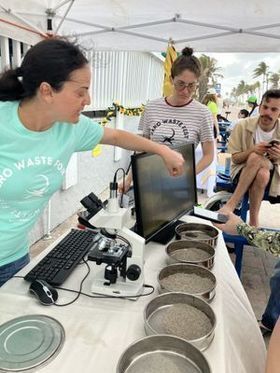
Dr. Sami Romanick conducts a microplastics demonstration for the public at the 2025 Zero Waste Fest.
Conventional glitter is built from a plastic core, usually polyethylene terephthalate (PET), the plastic that bottles and polyester clothing items are made of, and has a thin metal layer and a plastic coating. Because these glitter particles are smaller than 5 mm, researchers classify glitter as a primary microplastic. It has been found in rivers, wastewater sludge, and street dust.
Lab studies on algae, mussels, and small invertebrates have reported harmful effects, although research on glitter is still limited and mostly done under controlled conditions. In 2023, the European Union restricted the sale of loose plastic glitter for many uses.
"Eco" glitter isn't a free pass either. In one lab study, two commercial "biodegradable" glitters kept their shape after 96 days in water and seawater. The certifications behind those labels are tested under conditions very different from the ocean, so when glitter gets into the environment (because it gets everywhere, doesn't it?), even the "eco" ones aren't necessarily benign. Unfortunately, much of today's tinsel and many ornaments are plastic, and they shed microplastics.
Following the zero waste hierarchy, the best swap is to use less, then reuse what you already own.
Wrapping without the Plastic
Glitter, foil, metallic finishes, and plastic coatings can't be recycled with paper; they actually contaminate normal paper recycling. Try the scrunch test. If wrapping paper holds its shape when crushed, it's likely recyclable paper. If it springs back, it isn't.
Even better, skip the paper! Fabric wraps made from scarves or old shirts, paper bags, and saved ribbons can be used year after year. Wrapping a gift in a new scarf is a two-in-one gift! See our video for the Japanese art of fabric wrapping, furoshiki, below.
Holiday Textiles
Synthetic holiday "ugly" sweaters, stockings, table linens, and faux garlands shed microfibers as they are worn, washed, and dried. Studies of household dust, including one I conducted myself at the University of Rochester, find that most indoor microplastics are fibers and fragments from textiles and carpets. Polyester holiday textiles just add to the pile.
Additionally, in our Sodus BayWatch hands on plastic research with local K-12 students, we found microfibers in every sample we analyzed, from Sodus Bay water and sand to fish guts (this work is currently under review in the Journal of Emerging Investigators).
A few easy habits help reduce the microplastics during your holidaze. Thrift or swap your holiday clothes, wash full loads, and avoid the delicate cycle, since research shows the higher water volume releases more fibers. Hang drying helps too.
The Holiday Kitchen

More cooking means more contact between food and plastic. A 2023 study estimated that plastic cutting boards can shed grams of plastic per year in a heavy-use household. Wood cutting boards are a simple swap, and secondhand or homemade ones keep the cost low.
A 2023 lab study of plastic food containers found that any change in temperature such as microwaving or refrigerating released far more particles than other storage conditions or left at room temperatures. For leftovers, store in glass or stainless steel and move food to a plastic-free plate before reheating in the microwave.
A Quick Holiday Checklist
- Choose plain paper, fabric, or reused wrap over glitter and foil.
- Decorate with natural materials or secondhand pieces.
- Thrift or swap holiday clothing and wash it less.
- Use a wood cutting board for holiday prep.
- Store and reheat leftovers in glass, not plastic.
You don't have to do it all at once. Pick one swap this season, like fabric wrap instead of glitter paper, and build from there. Let the habits grow with you over time to other holidays and celebrations year-round!
Small habits that stick add up to less plastic in our homes and waterways.
Sources:
- Doval-Minarro et al 2025 Eco-glitter degradation study
- Romanick et al, 2025 Household Dust Study
- Hussain et al 2023 Microwaving plastic containers study
AI Transparency Statement: Samantha used AI to help find studies on the topic. It was not used for writing, editing, or publishing. Affirmed 27 October 2026.

Dr. Samantha (Sami) Romanick is a molecular biologist with an interest in studying the effects of microplastic exposure to human health. She is a Race to Zero Waste Board Member. Dr. Romanick currently works with the Environmental Working Group (EWG) as an Analytical Chemistry Fellow.